31-day returns policy Free delivery & returns More than 100,000 unique rugs Since 1998: Your expert in hand-knotted oriental rugs

28 Years of Nain Trading – Extra 20% Off
Celebrate 28 years of Nain Trading with us and enjoy an extra 20% off our entire range – including rugs already on sale.
Discount code: 28YEARS

Nain Trading

Berber Rugs

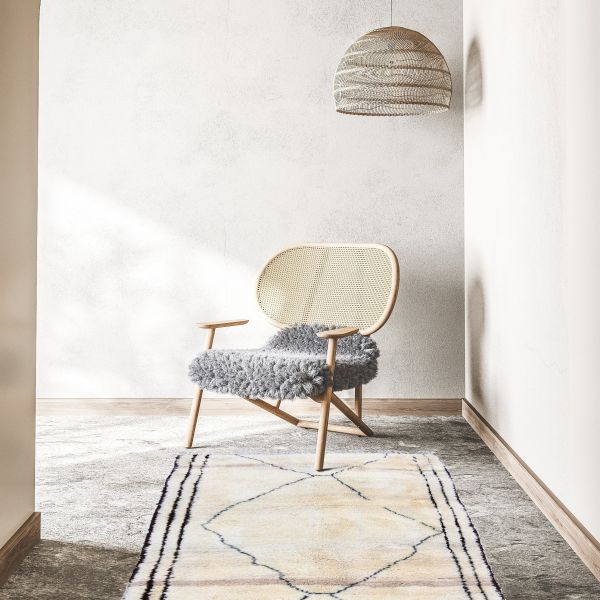
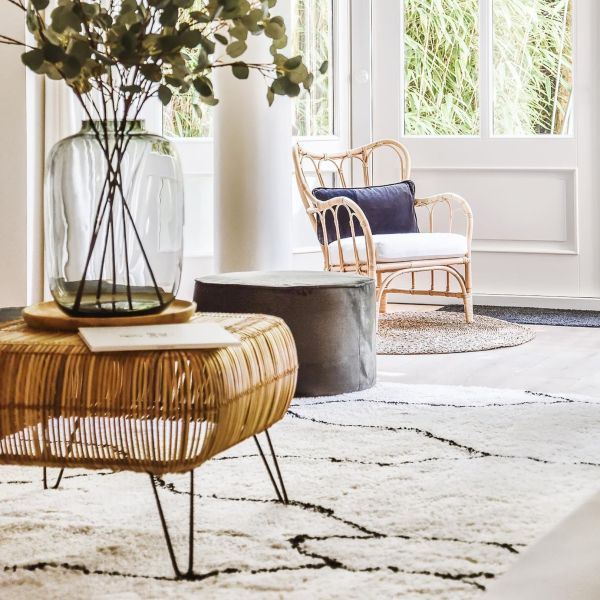
Cosy reading nook with a light Berber rug and natural materials

Berber Rugs: The Rustic Beauty of Traditional Craftsmanship

BY LAURA, RUG EXPERT AT NAIN TRADING | PUBLISHED: 2026-07-23 | 10 MIN READ

The history of Berber rugs goes back many centuries. In the Atlas Mountains of Morocco, Berber tribes were covering their floors with handmade pieces long before rugs became popular here as decoration.
They were not knotted for guests, but for everyday use. In winter as protection against the bitter cold in the mountains, in summer as a base on the hard floor.

But it did not stop there. Gradually, patterns were added: Diamonds stood for fertility, zigzag lines told of life’s journeys. Eye motifs were meant to ward off misfortune, crosses and other shapes often had a religious or nature-related meaning.
None of this was written down anywhere; it was simply passed on from generation to generation through the craft of knotting.

As a Moroccan rug, the Berber rug is now known worldwide and is no longer found only in Morocco. Hand-knotted rugs of this kind can be found in flats, lofts and houses all over the world.

Tip: If tradition matters to you, it is worth keeping an eye out for hand-knotted originals from Morocco.

What makes a genuine Berber rug?

The base is almost always pure new wool. It is warm, hard-wearing and feels soft to the touch. In some cases, cotton is added to make the whole piece more stable. Pieces with a silk content look particularly refined.
The fine threads give the patterns a subtle sheen and make the surface smoother. This looks elegant without the rug losing its practicality for everyday use.

Colours also play a major role. Some Berber rugs remain in their natural shades – cream, white, beige. Others are colourful and vibrant.

The patterns vary too: in one region, rugs are more often knotted in a strict geometric style, while in another they are full of symbols and intricate lines. Small irregularities are part of their character. They show that each piece was genuinely made by hand.

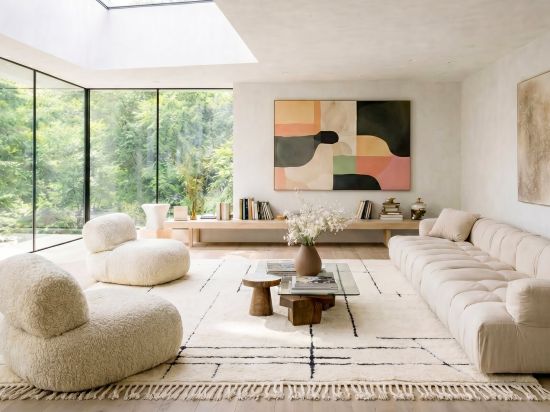
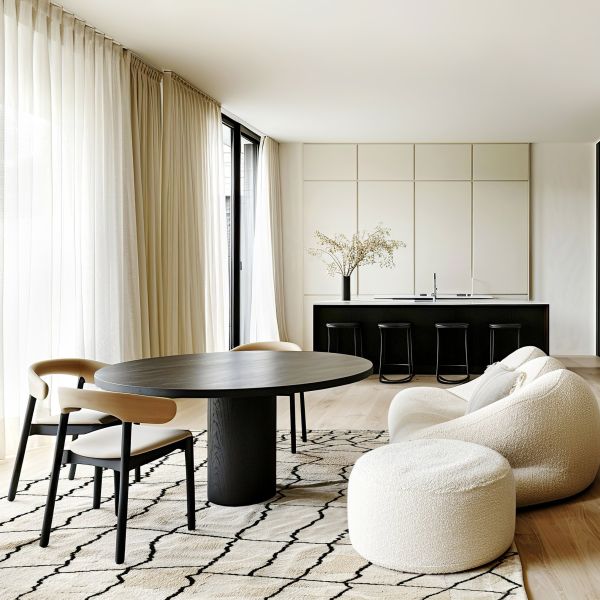
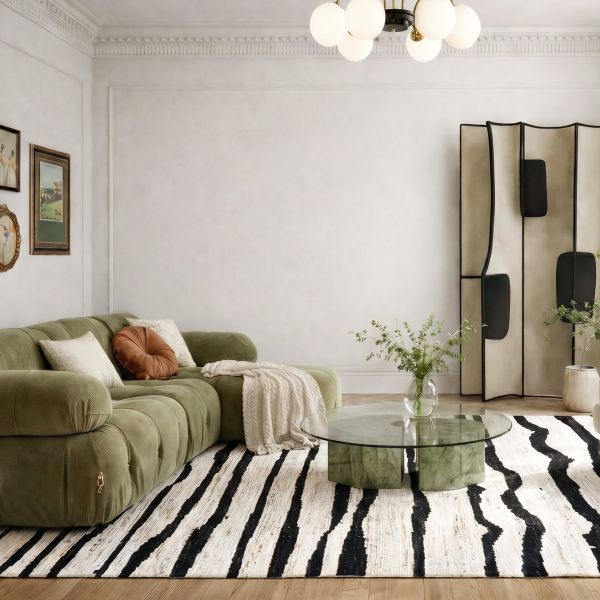
Modern designer rug in beige with a black line pattern in a minimalist living room

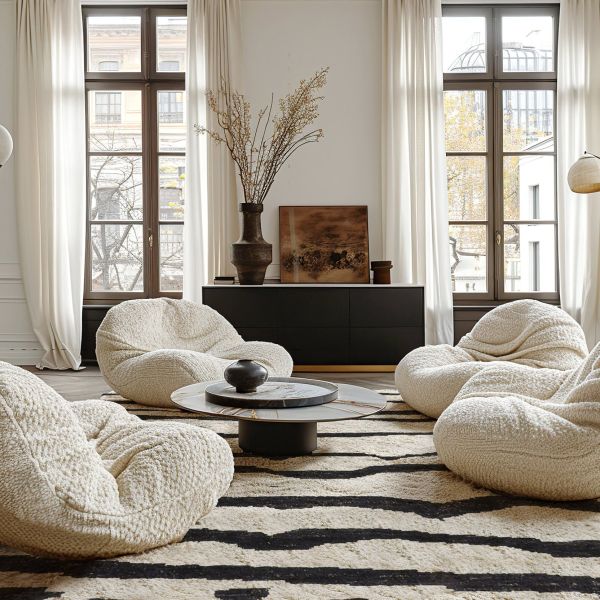
Beige Berber rug with brown stripes in the cosy living room

The most important types of Berber rugs

A Berber rug is not the same as every other “Berber rug”. There are several types , and they differ from one another.

The Berber rugs are tightly woven and very hard-wearing.
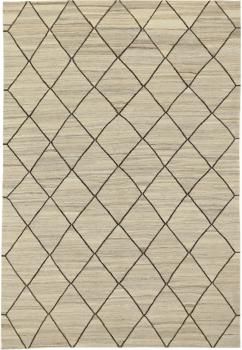
Geometric patterns set against a light background are typical. They have a simple look and suit almost any interior.

The Barchi rugs, often also called Moroccan Berber , are made in a slightly looser weave.
Many Moroccan Berber rugs are lighter in colour, while some are colourful. They feel lighter and bring a playful touch to the room :perfect for a child’s bedroom or even a home office if you want a more lively look.

Very well known are the Beni Ourain rugs . They are fluffy, deep-pile and usually white with black diamond patterns. This very contrast is what has made Beni Ourain rugs favourites in Scandinavian-style interiors. They look particularly striking on wooden floors.

Tip: If you like calm and simplicity, try a classic Berber rug or a Beni Ourain rug. If you want to add colour, look for a Barchi.

Benefits of Berber rugs

A Berber rug lasts a long time when properly cared for. Thanks to the craftsmanship, each piece is unique – no two look exactly the same. For many, that is precisely the appeal: you are not simply buying a rug, you are buying a one-off piece.

Many designs, especially the Beni Ourain, are among the typical high-pile rugs and are some of the most popular home accessories.

Tip: If sustainability matters to you, a Berber rug is a great choice. It is made from wool, silk or cotton, entirely without industrial mass production. This saves resources and makes these pieces more durable than synthetic fibre rugs.

Disadvantages you should know about

It does not come without drawbacks. A hand-knotted Berber rug is more expensive than a machine-made one. High-pile versions in particular require care, as they pick up dust and dirt more easily.

The weight should not be underestimated either. Large rugs are heavy.

Which rug size suits which room?

Size makes a big difference. A rug that is too small gets lost in the room. One that is too large can quickly make the space feel overcrowded.

In the living room, a size of 200 x 300 cm works well with two- to three-seater sofas. If you have a large seating area, 250 x 350 cm is the better choice. Important: The rug should sit under the front sofa legs, as this creates a more balanced look.

In the bedroom, it depends on the bed. For a double bed, 160 x 230 cm is a suitable size. In larger rooms, a 200 x 300 cm rug adds extra cosiness – and extends far enough out at the sides.

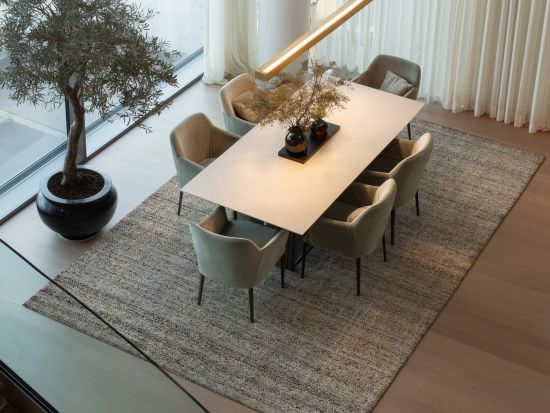
In the dining room, the rug needs to be large enough for the table and chairs to sit completely on it. For a table with six chairs, 200 x 300 cm is sufficient.

For larger dining tables, 250 x 350 cm is better, so the chairs stay on the rug even when pulled back.


Room Recommended size
Living room 200 × 300 cm
Living room (large) 250 × 350 cm
Bedroom 160 × 230 cm
Bedroom (large) 200 × 300 cm
Dining room 200 × 300 cm
Dining room (large) 250 × 350 cm

Tip: Mark out the dimensions on the floor with masking tape. This lets you see straight away whether the size suits the room.

Styling ideas with Berber rugs

Berber rugs are versatile. In simple rooms they make the space feel cosier. In classically furnished rooms they create a clear contrast.
Paired with wood, they feel warm; with glass or metal, they look cooler and more modern.

You can also combine several rugs. A large Beni Ourain in the living room, a colourful Moroccan Berber in the study, and a classic piece in the hallway – this creates an overall look that does not feel dull.

Tip: Fewer pieces of furniture and one striking rug are better. That way, it remains the focal point.

Care and Cleaning of Berber Rugs

To keep a Berber rug looking good for years, it needs proper care. Vacuum it regularly, ideally without a brush attachment. Every now and then, take it outside – fresh air does it good, but don’t leave it in direct sunlight. Treat stains immediately; sparkling mineral water often helps.
Very important: blot, don’t rub.

For a deep clean, it’s worth having the rug professionally washed every few years.

Tip: Rotate the rug from time to time so it wears more evenly.

How long does a Berber rug last?

A genuine Berber rug can last for decades if it is properly cared for.

Many people ask: How long does a Berber rug last?

With the right care, it can be twenty, thirty years or even longer.

In Morocco, they are often passed down within the family, sometimes over several generations.

Machine-made copies do not last that long. After a few years, they lose their shape and impact.

Tip: Do not see a Berber rug as a short-term purchase. With the right care, it will stay with you for many years.

Overview of Symbols and Meanings

Symbol Meaning
Diamond (◇) Femininity, fertility, protection. Often interpreted as a mother symbol. Two connected diamonds can represent marriage and starting a family.
Zigzag lines (~~~~) Life path, water, movement. Symbolises challenges, detours and protection against negative forces.
X or cross shapes (✕, +) Balance, connection between heaven and earth. Also used as a protective symbol against the evil eye.
Eye (◉ or ☉-like) Protection against the “evil eye”. A very powerful protective symbol, often placed centrally.
Diamond with dots (◇•) Pregnancy, new life. Dots can symbolise seeds or children.
Ladder or step shapes (▭▭▭) Transitions, ascent, spiritual journey. Often interpreted as a symbol of transformation.
Hand (similar to Hamsa) Protection, blessing, spiritual purity. Often shown abstractly as five lines or fingers.
Circle (○) Eternity, sun, wholeness. Also a symbol of the cycle of life.
Herringbone pattern (≋ or ||//||) Water, nourishment, life. An ancient symbol of abundance and prosperity.
Animals (goats, camels, birds – stylised) Depending on the animal: protection, fertility, freedom. More commonly found in rarer and more intricate rugs.

Frequently Asked Questions about Berber Rugs

Are Berber rugs also suitable for households with children?

Yes. Many Berber rugs are made from durable virgin wool and are well suited to living areas used every day. It is important to choose a suitable pile height and size for the room in question.

Can I combine a Berber rug with modern interior design?

Yes. Thanks to their simple look and natural colours, Berber rugs can be combined with both modern and classic furniture.

How often should a Berber rug be rotated?

It is advisable to rotate the rug every six to twelve months. This helps distribute wear more evenly and reduces one-sided wear.

Should a rug underlay be used under a Berber rug?

A rug underlay is not absolutely essential, but it can be useful. It improves slip resistance, protects the rug and increases walking comfort.

Can a Berber rug also be used in rented accommodation?

Yes. Berber rugs are well suited to rented accommodation, as they make rooms feel more homely while also helping to protect the floor.

How do I find the right size for my Berber rug?

The right size depends on the size of the room and the arrangement of the furniture. In the living room, the rug should ideally be large enough for the front legs of the sofa to sit on it, while in the dining room the table and chairs should fit completely on the rug.

Berber rugs for a cosy home

Berber rugs are more than just floor coverings – they are an expression of a centuries-old culture and at the same time a modern design feature. Whether you choose a classic Beni Ourain, a colourful Moroccan Berber rug or a geometrically inspired Berber-Ghashghai, with a Berber rug you are not only bringing a piece of tradition into your home, but also a unique work of art that adds warmth and character to your rooms.

Further inspiration

Close-up of a modern Gabbeh rug in dark design with fine patterning.
Cosy classics

Gabbeh

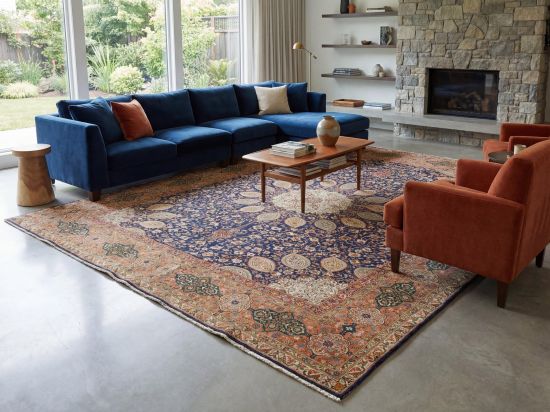
Hand-knotted oriental rug in an autumn-styled living room
Cosy Living Ideas & Tips

Rugs for Autumn

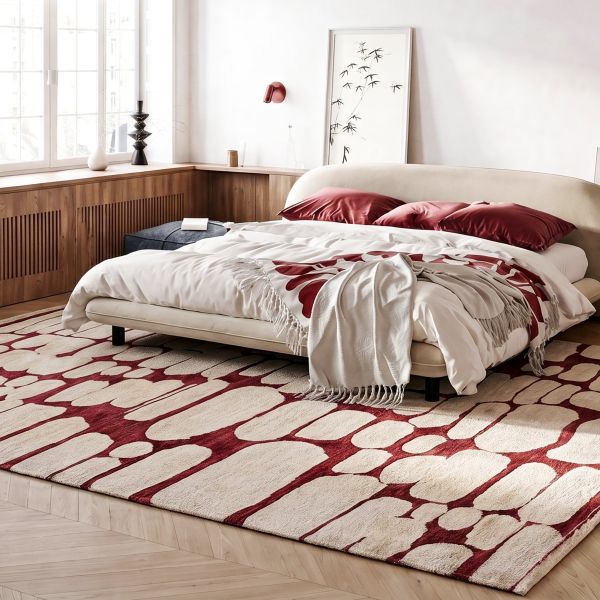
Bedroom with handwoven carpet in earth tones
Modern rugs with traditional craftsmanship

Texura